
Underlined terms in Confessd: the glossary balloon
Why some words are underlined
Confessd cases take place in art galleries, luxury trains, wineries, labs and many other places, and each one brings words not everyone knows. The problem is that the lead often hinges on exactly those words. If you don't know what an item or a place mentioned is, you might miss the contradiction without realizing it.
That's why every case has a short glossary. The terms appear with a dotted underline, in the same color as the text. Tap the term and a balloon opens with its name highlighted and a short explanation below. The glossary is just a reading aid: it gives no points, reveals no clues, uses up no questions and changes nothing in the game.
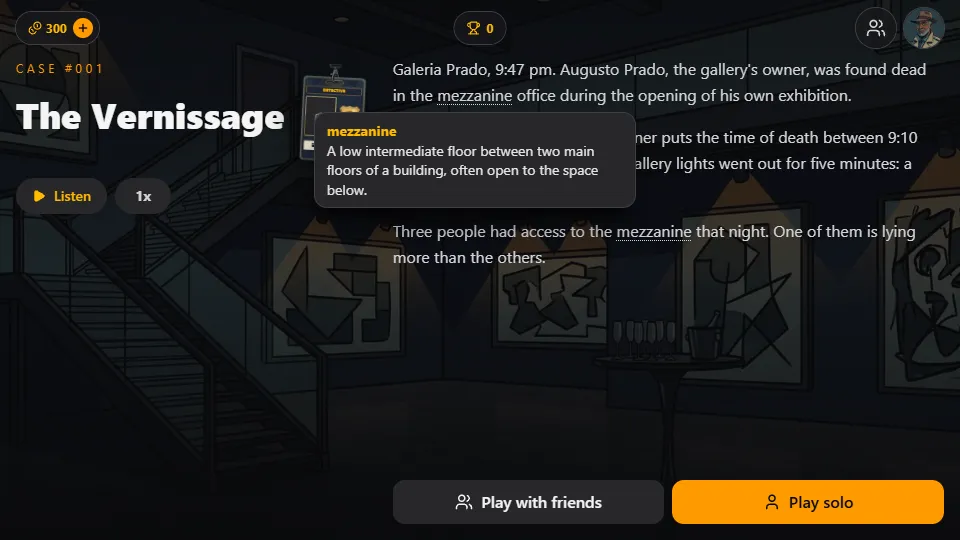
Examples from the first cases
In case 001, The Vernissage, the case text starts with two underlined terms right away. "Vernissage" is a private viewing or opening night of an art exhibition, held before it opens to the public. "Mezzanine" is a low intermediate floor between two main floors of a building, often open to the space below.
In case 002, The Midnight Express, you'll find "Simplon", the Alpine pass between Switzerland and Italy, with one of the longest railway tunnels in Europe beneath it, and "vetiver", a tropical grass whose roots yield an oil used in perfumes. One of the suspects is a "lady's companion", a term the balloon explains as a woman employed to live with and assist a wealthy lady.
Notice that the explanation describes the word in general and never talks about the case, the suspects or the place. The balloon teaches the term; drawing the conclusion is still up to you.
Where the underline appears
The underline applies to the case texts in play: the case text (on the opening screen and in the case sheet), the scene description, the suspects' answers (including answers to questions you type), events, clues and forensic reports. It doesn't appear on question buttons, accusation options, suspect names or interface text. In each line, the term is marked only the first time it appears.
In answers that appear letter by letter, the underline shows up once the text finishes typing out; before that, a tap just skips the typing. The balloon closes with a tap anywhere or with the Back button, and only one stays open at a time. It follows the text size you chose (A, A+ or A++).
A list for each language
The glossary isn't translated word for word. Each of the 13 languages has its own list, chosen for people reading in that language: a dog breed that's common in one country may need explaining in another, and a word that's hard in Japanese may not be hard in English. That's why the same case can have different underlined terms depending on the game's language, and some cases have none at all.
On the website, each case page also shows the balloon on the terms that appear in the case's public text (briefing, scene and the suspects' roles).
Frequently asked questions
Does tapping an underlined word use up a question or coins?
No. The glossary balloon is just a reading aid. It doesn't use up questions or coins and changes nothing in the game.
Does the glossary give away leads in the case?
No. The explanation defines the term in general and never mentions the case, the suspects or the place. Connecting the term to the lead is still your job.
Why does my friend see different underlined words than I do?
Because each language has its own list of terms, chosen for people reading in that language. If you play in different languages, the terms change.