


Bruno Kessler
Night watchman of the commuter rail line, 49
Bruno Kessler is 49 and for twenty years has watched the tracks of Berlin's commuter rail by night. He was born in Cottbus, the son of a freight train engineer and a canteen cook, worked for years on road construction and joined the railway at 29, when his back asked for a job with more walking and less carrying. He knows every sleeper on his stretch and says the tracks, in the small hours, say more than many people.
He lives with his wife in a prefab block apartment on the city's eastern outskirts, on the eighth floor, with a balcony where she grows geraniums and he leaves his work boots to air. He sleeps in the morning with the blinds shut and has dinner at noon, while the whole building has lunch. In the kitchen a thermos of coffee is always full, and the living room radio only plays football matches.
He has a broad, ruddy fair face, a trimmed gray beard and a black wool cap pulled down to his eyebrows, which he takes off only to sleep. He wears the railway's orange reflective vest over a quilted blue jacket and carries a big flashlight on his belt, which he switches on out of habit even under a streetlamp. He is laconic and wary of the police, answers with the minimum and weighs each word before spending the next.
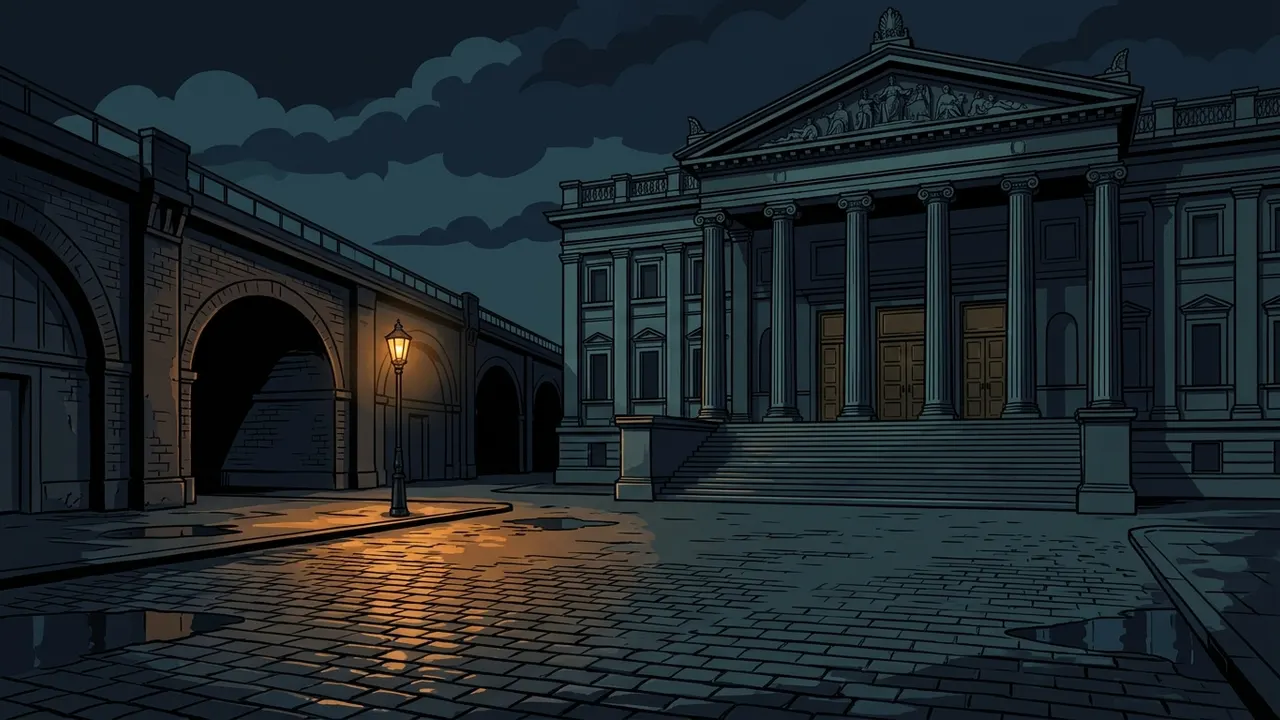
About the small hours, his account is that of someone who found the trail: at 4 a.m. he found a wheelbarrow overturned between the tracks, a thick rope tied to the parapet and an aluminum ladder leaning against the museum wall, as if someone had moved house over his viaduct. He says it blows up there like at sea and that no sound of glass gets past the wall, and that at that hour the viaduct had no trains, because the trains sleep more than he does. With the museum next to the viaduct and the small hours empty, no one can say for certain where each person was at that hour.
Bruno knows that the man who watches the tracks the gold left by has to explain why he saw nothing. When the detective asks if he helped carry the coin, the dryness turns to anger: he recalls his twenty years on the railway, asks if he now hauls gold in a wheelbarrow and demands proof before being called a thief. It may be the outrage of an honest worker treated as an accomplice. It may be someone who answers little so as not to have to answer the rest. The detective will have to decide which.


Cases unlock in order, like levels. This is case 112 of 200.
The case
The other suspects
 Ingrid HallerCurator of the coin cabinet, 58
 Kai BrandtNight shift security guard, 23