
The Somerton Man and the "Tamám Shud" slip
Adelaide, Australia, 1948
This case is a work of fiction. The characters, names, places and events in the game do not portray real people. The account below is a factual summary, based on public sources, of the case that served as inspiration.
At about 6:30 am on December 1, 1948, police were called to Somerton Park beach, near Glenelg, south of Adelaide: a couple had found a dead man propped against the seawall, legs stretched out and feet crossed, with a half-smoked cigarette in the collar of his jacket. He wore no hat and carried no wallet or papers, and every label had been torn from his clothes. The night before, people passing the spot had seen a similar man lying in the same position, motionless.
The autopsy found no poison, but the pathologist John Dwyer said he was "fairly convinced" the death was not natural, and a pharmacology professor testified about poisons that leave no trace, later suggested to be digitalis and ouabain. In mid-1949, in a fob pocket hidden in the trousers, a rolled slip of paper was found bearing the Persian words "Tamám Shud" ("it is finished"), torn from the last page of a copy of the Rubaiyat of Omar Khayyam. A man handed the police the book, which he said he had found in a car on Jetty Road in Glenelg; on the back cover were the phone number of a former nurse who lived nearby and five lines of capital letters that no one ever deciphered.
Sources
In the game
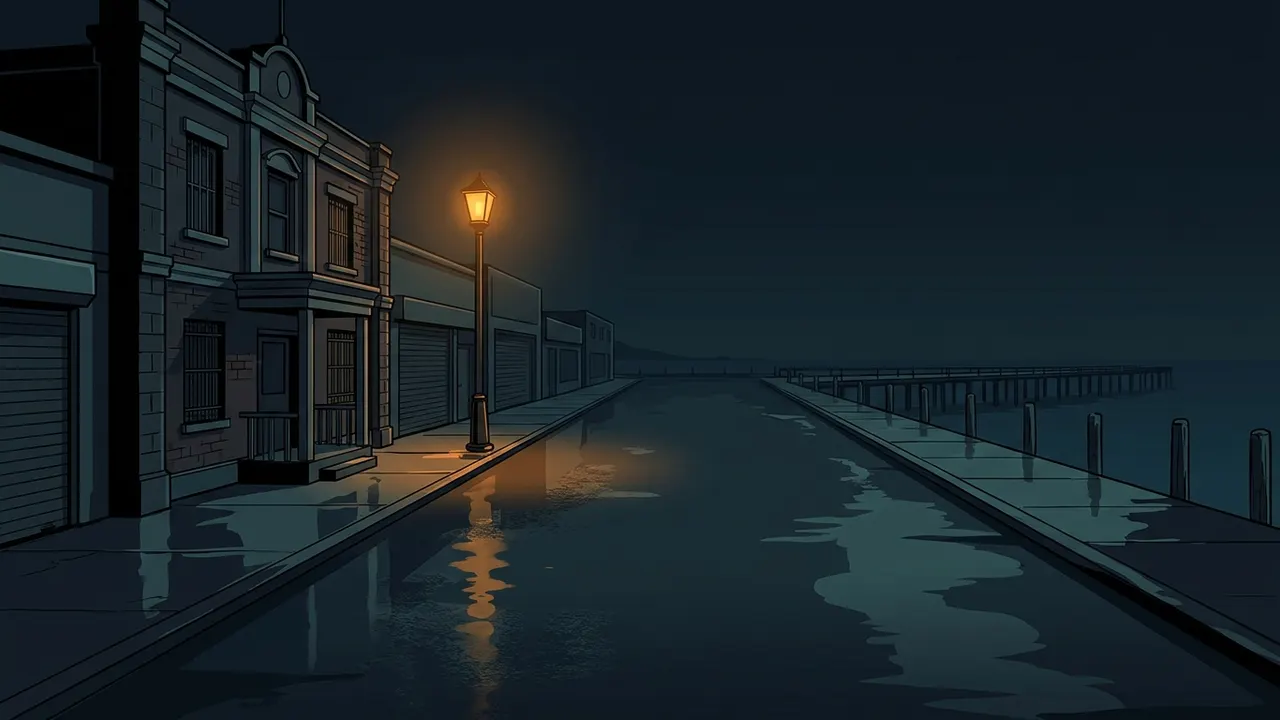
Crossed Feet
Adelaide, Wednesday, December 1, 1948, 10 pm. At the Glenelg police station, the ceiling fan turns slowly and the smell of the sea drifts in through the open window.
The inquest could not say who the man was or what he had died of. The body was exhumed on May 19, 2021, and in July 2022 Professor Derek Abbott of the University of Adelaide and the genealogist Colleen Fitzpatrick announced, through genetic genealogy, that he was probably Carl "Charles" Webb, an electrical engineer born in Melbourne in 1905. South Australia Police did not officially confirm the identification. The game borrows the beach, the crossed feet, the cut labels and the hidden slip of paper; the doctor, the nurse, the pharmacist and the outcome are fiction.