
How to climb the Confessd leaderboard
Where your points come from
The Confessd leaderboard is the sum of the points from all your games. There's no average or per-case grade: the more points, the higher you rank. The table is short and the same for everyone.
Every new clue that goes into your Clues is worth +5. It doesn't matter whether it came from a ready-made question, a typed question or a forensic test: if the fact is revealed for the first time, the points come in right away. A forensic test that reveals nothing, like Scene photos, gives no points.
Closing the case is worth more. The arrest (a correct accusation) earns +50. If the suspect confesses during the interrogation, the confession ends the game with a win and earns +100, instead of the arrest's 50, never on top of them. A wrong accusation, whether the suspect or the evidence is wrong, takes off 10 points.
After the win you can still score in the post-case room: every confrontation completed in Face-off is worth +2 and every clue correctly linked on the Evidence board is worth +1.

What only counts once
A clue's point is permanent per account, per case and per clue. If you lose and play the same case again, the clues you already revealed don't pay out again. So losing on purpose to replay the case gets you nothing and still costs 10 points.
Your total never goes negative. If you have 4 points and accuse the wrong person, the game only takes off those 4 and your total stops at zero. The same goes for the points in each leaderboard period.
A case with 10 clues closed with a confession is worth 150 points. That's the practical ceiling for a game, not counting the post-case room. In other words: the confession alone is worth as much as twenty clues, and it's what separates those who climb fast from those who climb slowly. The guide How to get a confession shows how to get there.
Today, Week and All time
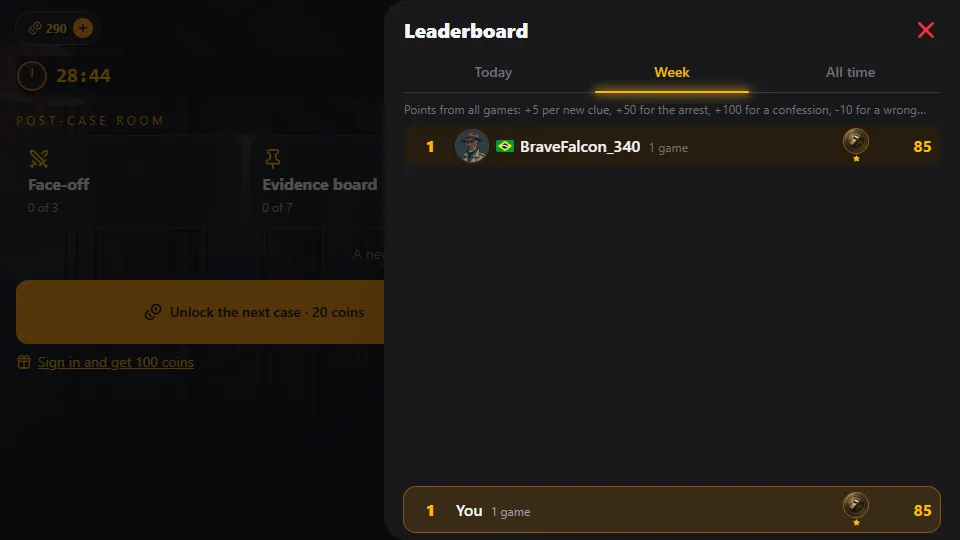
The leaderboard has three tabs: Today, Week and All time. Each one only adds up the points earned in that period. In the app, the leaderboard sheet opens on the Week tab; to open it, tap the points score at the top of the screen.
In case of a tie, whoever needed fewer games in the period comes first. If it's still tied, whoever got there first wins. That's why getting it right the first time pays off twice: you add the 50 or 100 points and don't spend games on losses.
Each row shows the position, the avatar, the detective name, the flag of the country set on the device, the Senior Detective badge (subscribers can hide it in Settings), the rank, the number of games and the total points. Everyone joins the leaderboard from their first point.
On the website, the Ranking page updates every 5 minutes. In the app your position shows up faster, and at the end of each game the Score screen shows the points from that game, your new total and your overall position, with how many places you went up or down.
How to climb faster
Go for the confession. It doubles the arrest reward and ends the game on the spot. Ask the questions that put pressure on the suspect and watch their face.
Reveal clues before accusing. Every new fact is worth 5 points and also helps you get the accusation right. A well-chosen forensic test can bring both a clue and points.
Don't guess. A wrong accusation costs 10 points and one extra game in the tiebreaker. If you're not sure, go back to your Clues and check what each suspect said.
Make the most of the post-case room. Face-off confrontations and Evidence board links add points while you wait for the next case.
Frequently asked questions
Does losing a case take away my clue points?
No. The clues you already revealed still count. A loss takes off 10 points, and your total never drops below zero.
Do a confession and an arrest add up to 150 points?
No. The confession is worth 100 instead of the arrest's 50. What adds to it are the 5 points for each new clue.
Why is my position on the website different from the app?
The website ranking updates every 5 minutes. Wait a bit and reload the page.